Thursday, August 10, 2023

Amazing Chinese Characters (609) Carve - 琢

The big seal of character Carve is

The left is character Jade (Post 244), the right part is character Skeleton (Post 607), here it means very hard and sharp knife used to carve Jade.


The small seal script of character Carve is
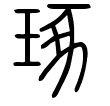
Similar to big seal script.

The clerical script of character Carve is

Similar to older scripts.

The pinyin of the character is Zuo2.


Amazing Chinese Characters (608) Large Grave - 冢

 The bronze script of character Large Grave is


The inside-left is character Skeleton  (Post 607), which is similar to character Pig 


If you look carefully, you could find that the character Skeleton has an extra short line on the bottom of the middle vertical curve, pointing to left. It is a trotter, mainly composed of bone.

The outer-right is a cover.

The character means that a large grave covering bones, here are human skeleton. In the ancient time, after people with power or high rank officials died, they were buried very deep and a large grave on the top to show their important not only when they were alive, but even after they died.

The big seal script of character Large Grave is


The cover is almost a circle, inside is character Skeleton.

The small seal script of character Large Grave is


Similar to big seal script.

The clerical script of character Large Grave is

The bottom is character Skeleton, the top is the cover, much smaller cover because it can write faster.


Wang-Zhaojun (王昭君)Grave

The Pinyin of the character is Zhong3.

The character is not used often right now. 


Amazing Chinese Characters (607) Skeleton - 豖

 The shell bone script of character Skeleton is

One dot on the left and one 

which is shell bone script of character Pig (Post 111).

The original meaning of the character is the Pig Leg Bone, the dot indicates the lower part of the pig.

The small seal script of the character Skeleton is

One short line crosses three legs of the pig. Let's see the corresponding small seal of Pig

The top horizontal line is the pig head, the left three falling down lines + the middle curved left line are four legs, and the right curved down line is the tail. 

The meaning is the pig legs, indicating the bones. 

However, the all dictionaries explains that the meaning is that a pig tied its legs walks difficultly. It looks like the legs are tied, but it means leg bones. 

The character has no bronze, big seal, even clerical scripts, which indicates that the character was abandoned long long time ago, however many compound characters have it as a part. We can find that its meaning in those characters is bone or as hard as bone.


Friday, August 4, 2023

Amazing Chinese Characters (606) Open - 启(啟)

 The shell bone script of character Open is 


The top left is character Household - 户 (Post 271), meaning a single door. The top right is a hand opening the door. The bottom looks like character Mouth - 口(Post 16). It is believed that the first character had no Mouth. The meaning of the character is to Open the door. Later, the Mouth - 口 was added to mean "Teaching, Guiding for Beginners", open a door for skills and knowledge.

The big seal script of character Open is

Similar to shell bone script.

The small seal script of character Open is


The left 启 is 户(top - character Household) + 口(bottom - Mouth), the right is a hand (lower part) holding a stick (higher part), which means "knock, hit" here. The stick here should be a tool for opening door. 

The clerical script of character Open is
Similar to small seal script but the 口 - Mouth moved to the middle of bottom.

The simplified song type face of character Open is


Just the left half of the small seal script, the right part - Hand eliminated.

The Pinyin of character Open - 启(啓)is Qi3.

There is another character Open - 开 -開 (Post 359), its original meaning is to Open double door. 

The difference between the two: 
开(開)means Open, such as open a door, open to public, open a tournament (e.g. U.S. Open), open to talk, etc.
启(啓)means start up, start, inspire, announcement, notice, etc.

They are similar in most situation, however, 启(啓)is more formal, more mental, conceptal,  and used more in writing; 开(開)is a little bit more informal, could be used both in writing and oral Chinese. Another big difference between the two is 启(啓)is not used in physical open anything anymore, all those open is 开(開).


Thursday, July 27, 2023

Amazing Chinese Characters (605) Image - 像

 The big seal script of character Image is 

The left is character Person (Post 37), the right is character Elephant (Post 128). 

Elephants lived in China thousands years ago, people call it as Yellow River Elephant because they lived in the Yellow River area. As the weather changed, forest disappeared in north China, so elephants disappeared in north China and most south China. Small number of elephants live in Yunnan, near Burma.

When elephants disappeared from most of China, many people couldn't see elephant, but listened the animal by legends, they could only imagine elephant. So character Elephant means "similar to", "look like", not direct "be". It forms words with other characters to express anything with your imagination, e.g. “想象“-imagine, "抽象“ -abstract. Anyway, something you couldn't see, but you could imagine by the information you heard, which is Thinking-Elephant - 想象, imagining the elephant.

The image from imagination was formed in our mind, in 3500+ years ago, there was no paper, it is very difficult for people to draw the images on bamboo slips. However, in Han Dynasty, people knew to make paper, then they could draw the images in their mind on paper, they had a physical media with image. They created character Image as above to present it. All pictures, paintings, drawings could be presented by the character.

The small seal script of character Image is


The left is character Person, the right is character Elephant.

The clerical script of character Image is
The left is Radical Person, the right is character Elephant.

The Pinyin of character 像 is Xiang4, same as character Elephant (象).


Sunday, July 16, 2023

Amazing Chinese characters (604) Young - 幼

 The shell bone script of character Young is

The top is character Power or Strength (Post 168), which is a plow. Hanging on the plow is character Give (Post 597), which is spider silk. Young kids are very weak, their strength is like spider silk, couldn't hold anything at all. 

The bronze script of character Young is 


The plow is across the spider silk, or both sides of plow have spider silk.

The small seal script of character Young is


The spider silk is on the left, the plow is on the right.

The clerical script of character Young is 


The left is character Youngest (Post 407), the right is character Power or Strength. 

The Pinyin of character Young is You4.

幼 means very young, normally from 1 year baby to 6 years old, occasionally could go 12.  


Thursday, July 13, 2023

Amazing Chinese Characters (603) Lodging - 宿

The shell bone script of character Lodging is

The out contour is a house, the left in the house is a Person (Post 37), the right is a sleep bamboo mat. A person is sleeping on a bamboo mat in a house, which is Lodging for night. 

The bronze script of character Lodging is 


Similar to shell bone script except the bamboo mat is on left, and person is on the right now.

The small seal script of character Lodging is


The person is on left, and right is not like a bamboo mat anymore. I don't know why it changed to that.

The clerical script of character Lodging is

The top is called Radical Treasure Cover, meaning the roof of a house. Under it, left is Radical Person, the right is character One Hundred, which has nothing to do with bamboo mat. No idea why it is here.

The pinyin of character 宿 is Su4.

宿 means a house for people to sleep over night: lodge + sleep + night. It would not be 宿 if any one is missing. That is "lodge + sleep", "lodge + night", "Sleep + night", are not  宿。The home house, the dormitory, the hotel, are 宿. The car where people take a nap is not 宿“.


Wednesday, July 5, 2023

Amazing Chinese Characters (602) Neighborhood - 邻(鄰)

  The big seal script of character Neighborhood is

The top is character Hot (Post 185), which contains two character Fire (Post 26)


The bottom are two feet. 

The character means that the place where is bonfire is just walking distance, which of course is the neighborhood in the ancient time when people shared the bonfire.

The small seal script of character Neighborhood is


The left is similar to big seal script, the right is character Village (Post 561), where people reside in. 

The clerical script of character Neighborhood is


The left top is character Rice - 米 (Post 163), which is totally wrong from the original meaning. It may look like a little bit the character Hot - 炎? The right part is called Right Ear Radical, meaning place where people reside.

The traditional song typeface of character Neighborhood is 


Same as clerical script.

The simplified song typeface of character Neighborhood is


The left is character Order - 令 (Post 152), nothing to do with neighborhood, only pronunciation is same. This is very bad simplification.

The Pinyin of character Neighborhood is Lin3.


Amazing Chinese Characters (601) Laborer - 巴

 The shell bone script of character Laborer is


It is said that there were people with many hands who lived in Sichuan area where many high mountains. They could climb mountain quickly, they are very handy, the best laborers.

The big seal script of character Laborer is


We can see a person kneeling down, bending back, lowing head. But the arm with many hands disappeared, the reason may be the character presents real person, not imaginary person.

The small seal script of character Laborer is


Similar to big seal script.

The clerical script of character Laborer is

Not like the older scripts. I can't figure out how it changed to this form.

The Pinyin of character Laborer is Ba1.

The character is not used for Laborer anymore now but the meaning is implied in compound character with it, and the proverbs containing it. 


Monday, July 3, 2023

Amazing Chinese Characters (600) Relax - 舒

 The big seal script of character Relax is

The left is character Residence (Post 599), the right is character Give (Post 597), here means silkworm silk. People who live in a small house in a remote area, and raise silkworm to produce silk, feel relaxed. Another possible is that the character Give means spider net here. Spider net means remote area, quiet, if you live in a small house there, you feel relaxed. I prefer the latter explanation.

The small seal script of character Relax is

Similar to its big seal script.

The clerical script of character Relax is

The left is character Residence, the rifer is character Give.

The Pinyin of character Relax is Shu1.
 
舒 also means Comfortable.